From Chalk Marks to Computer Vision: 150 Years of Hull Inspection Evolution
Standing in the Lloyd's Register Heritage Centre, looking at surveyor reports from 1764, I'm struck by how little the fundamental challenge has changed. Ships still need to be inspected. Hull integrity still determines seaworthiness. The only difference is that we've traded chalk marks and clipboards for ROVs and AI algorithms.
12 min read
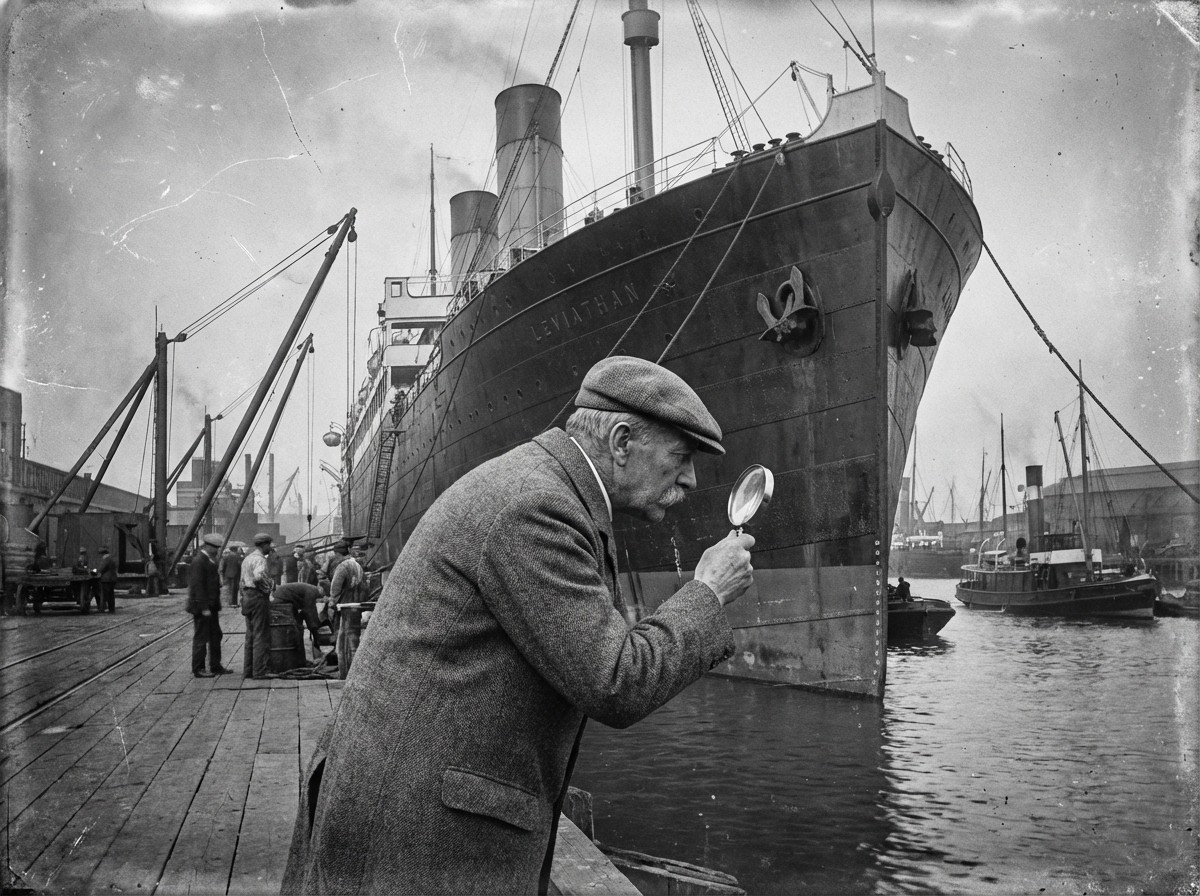
While working for one of America’s largest oil primes (can’t say which), I stumbled upon another esoteric but magnificent industry: subsea inspection.
One rabbit hole led to another. I started reading about how oil rigs are maintained, which bled into maritime operations → hull inspections → economics of drydocking → ROV operations → and finally (somehow) to a Lloyd’s Register archive room, staring at surveyor reports from 1764.
I was struck by how little the fundamental challenge has changed.
Ships still need to be inspected. Hull integrity still determines seaworthiness. We've traded chalk marks and clipboards for ROVs and AI algorithms, but the job description hasn't really moved. What follows is what I found digging through 260 years of that evolution, and what I think it tells us about what comes next.
The global subsea and offshore services market was valued at $15.56 billion in 2024 and is projected to reach $27.97 billion by 2034. The inspection, maintenance, and repair segment alone captured $4.39 billion in revenue in 2024, the fastest-growing slice of the market. The dry docking services market hit $22.99 billion that same year. This is not a small industry. It just operates where most people aren't looking, even though the industry’s success dictates whether or not your favorite spices will be at your local grocery market to whether or not your entire district will have power that month.
It Started in a Coffee House
Lloyd's Register, the organization that essentially invented modern ship classification, originated at Edward Lloyd's coffee house on Lombard Street in the City of London. From the late 17th century onwards, Lloyd's coffeehouse was a popular meeting place for sailors, merchants, and shipowners, and Edward Lloyd catered for them by providing reliable shipping news. Few London merchants had their own offices at this time; they transacted much of their business at the Royal Exchange, and coffee houses became centres for specialized interests. In 1696, Lloyd started publishing a paper called Lloyd's News three times a week to feed the appetite for shipping intelligence.
The entire multi-billion-dollar inspection industry traces back to a group of insurance underwriters sitting in a London coffee shop, trying not to lose money on bad ships.
In 1760, The Register Society, made up of underwriters, brokers, shipowners, and merchants who associated through the coffee house, was formed to publish an annual register of ships. This was the world's first classification society.
Classification societies would later become the judges and jurors of anything that crosses the Atlantic or is accepted into public ports.
How Surveyors Actually Graded Ships in 1764
Starting in 1764, subscriptions for the Society's annual Register Book funded surveyors to list, rate, and class the condition of vessels. The earliest Register Book contained the details of 4,118 ships, including past and present names, the master, number of crew, owners, guns carried, when and where built, and crucially, the classification given.
Here's where it gets interesting if you care about the origin of standards. The grading system was elegantly simple. According to an Oxford case study on Lloyd's Register, hull quality was rated using vowels: A for excellent, E for good, I for indifferent, O for old, and U for unsound. Equipment (masts, rigging, anchors) was graded G (good), M (middling), or B (bad).
Over time, G, M, and B were replaced by 1, 2, and 3. The 1775–76 Register combined these into "A1": hull in the highest class, equipment in first-rate condition. That's where the English expression "A1" meaning first-class comes from. It was invented by ship inspectors.
The early surveyors' workflow was refreshingly simple: walk around the ship, look at it, write down what you see. No sophisticated equipment, no remote monitoring. Just trained eyes and experienced judgment. They marked defects with chalk and recorded observations on paper forms that, honestly, would look familiar to any surveyor working today. The surveyor assessed the hull visually, noted any damage or rot, examined the rigging and fittings, and rendered a judgment that directly determined the insurance premium.
Rope belaying was a huge change to the industry. Instead of eye-balling large ship sections from a distance, more daring surveyors repelled down the sides of ships, marking corrosion or hull details as they descended over rough waters.
No algorithm. No sensor. Just a human standing on a dock with a notebook.
Iron, Steel, and the First Standards War
As steam superseded sail and timber gave way to iron and steel, ships of unprecedented size were built. Lloyd's Register met these challenges by drawing on practical experience to formulate guidelines for existing ships and those under construction.
Here's a piece of the history that matters for understanding why standards wars are so persistent in this industry. A dispute over the system of classification led to rival Registers: the shipowners' "red book" and the underwriters' "green book."
Shipowners wanted more lenient classifications (lower insurance premiums); underwriters wanted stricter ones (less risk). This tension between the party being inspected and the party relying on the inspection results has never gone away.
The dynamic remains today between vessel operators and classification societies over AI-based inspection acceptance criteria.
The rivalry was resolved in 1834 when they reconstituted as Lloyd's Register of British and Foreign Shipping. In that first year, sixty-three surveyors were employed, and by 1840, 15,000 vessels had been surveyed in accordance with the new unified Rules. That's the power of standardization: from two competing systems to 15,000 surveys in six years.
The Maltese Cross: the First "Digital" Certification
“A1”, “U2”, and various letters and numbers are difficult to check at a glance. A better system that everyone understood without a matrix was needed.
In 1853, it was Thomas Menzies' idea to use the Maltese Cross ✠ in the Register Book and on classification certificates to denote a ship built under special survey. Menzies had been sent to Quebec in 1852 as the Society's first overseas resident exclusive surveyor. The Quebec Board of Trade had made repeated requests for a surveyor due to the number of ships being built on behalf of British owners. He and his assistant, Charles Coker, did much to help local shipbuilders raise construction standards.
The Maltese Cross was a physical symbol indicating inspection quality, a trust mark that could travel with the ship across oceans and be immediately recognized in any port. It's a remarkably analog precursor to today's digital certification processes. Same idea, different medium.
Standardization matters more than individual brilliance. The most skilled surveyor in the world can't create industry-wide confidence without consistent, reproducible methods. The same will be true for computer vision.
Going Global (the 1850s Version)
The expansion from London forced procedural innovation that feels eerily modern. Surveyors couldn't just examine ships. They needed to document findings in ways that could be understood and trusted across cultural and linguistic barriers.
After Menzies in Quebec, further appointments followed: Antwerp in 1866, Rotterdam in 1868. Louis Meyer, the Antwerp surveyor, seems to have been the first person appointed with responsibility for an entire country when he was promoted to cover Belgium in 1869. Joseph Tucker was transferred as exclusive surveyor to Shanghai in 1869. By the early 1880s, almost half of the world's shipping was classed by Lloyd's Register.
That wasn't just commercial success. It represented the triumph of systematic inspection methodology over ad-hoc individual assessment. Just as Lloyd's Register had to develop procedures that worked across continents in the 1880s, today's inspection companies must develop digital workflows that function across wildly diverse offshore environments, from the North Sea to the Gulf of Mexico to deepwater West Africa.
Beyond Ships: the Inspection Expertise Transfer
Inspection of materials and fabrication was always intrinsic to the classification process. By the early 1800s, Lloyd's Register surveyors were expanding beyond visual inspection to materials testing: anchors, cables, the quality of iron and steel itself.
Then came the non-marine work. Refrigerated cold stores for the Port of London Authority in 1911. Quality assurance for shell steel for the French military during the First World War. Copper pipes and other items for shipping in the USA. By 1934, surveyors were inspecting 10 million cubic feet of cold storage, not just in the UK but in Antwerp, Basel, the Congo, Singapore.
inspection expertise transfers across applications. The same systematic approach that validated ship hulls could be adapted to industrial facilities, storage systems, and manufactured components. The domain knowledge matters, but the methodology is portable. Models trained on hull corrosion can be adapted to pipeline inspection, wind turbine blades, and offshore platform structural assessment.
The Nuclear Leap
The Second World War accelerated everything. Lloyd's Register helped validate numerous innovations, and the post-war period saw the first major technology-driven transformation in inspection methodology.
LR provided consultancy and inspection services to atomic energy plants, including the UK's Calder Hall, which in 1956 became the world's first nuclear power station to generate electricity on an industrial scale.
Nuclear inspection requirements forced the industry beyond visual assessment into sophisticated non-destructive testing (NDT): X-ray imaging, ultrasonic testing, magnetic particle inspection. For the first time, hull inspectors regularly used equipment more complex than measuring calipers.
Wwhen Lloyd's Register first adopted X-ray inspection for nuclear applications, it took years to develop interpretation standards that consistently identified relevant defects versus benign variations. We are making the exact same learning-curve mistakes with AI-powered inspection right now, but with higher stakes and compressed timelines.
Containers Changed Everything (Again)
In the 1960s, containerization revolutionized the global flow of goods, and ships became ever larger. Traditional surveyors trained on general cargo vessels had to adapt to massive, specialized ships with complex structural requirements.
The inspection methodology had to evolve from examining individual steel plates to understanding integrated systems. A surveyor using 1940s techniques on a 1970s container ship would miss critical structural issues that simply didn't exist in earlier vessel designs.
Inspection methods must evolve with the thing being inspected. It sounds obvious stated plainly, but the industry has historically lagged by a decade or more every time ship design leaps forward.
The Offshore Problem
The oil crisis of the early 1970s led to a deep depression in shipping, but Lloyd's Register rode the storm through its involvement with the expanding energy industry, particularly the pioneering development of oil and gas extraction under the North Sea.
Offshore platforms introduced inspection challenges that traditional maritime surveyors had never faced. Structures permanently installed in harsh marine environments. Complex integrated systems combining maritime and industrial elements. Inspection access limited by weather, tides, and operational constraints.
This drove the first serious adoption of remote inspection techniques. When you can't get a surveyor to a platform for months because the North Sea is trying to kill everyone, you need alternative assessment methods. And this, more than anything else in the 260-year history, set the stage for where we are now.
How Hull Inspection Actually Works Today, Step by Step
Now you’re a 15 minute expert on the history of inspection. What actually goes down in an inspection?
It's a surprisingly rigid, multi-year cycle governed by international law, classification society rules, and a lot of logistical complexity.
The Five-Year Survey Cycle
Under SOLAS (Safety of Life at Sea) and IACS (International Association of Classification Societies) rules, which cover over 90% of the world's cargo-carrying tonnage, every classed vessel follows a five-year survey cycle that includes:
Annual Survey: Conducted within 3 months before or after each anniversary of classification. General external inspection of hull, machinery, and equipment. Depending on vessel type, an annual survey can take several hours to a few days.
Intermediate Survey: Replaces the second or third annual survey. Particular attention is paid to cargo holds in vessels over 15 years of age and the operating systems of tankers, chemical carriers, and gas carriers.
Special Survey (Class Renewal): The big one. Conducted every five years. Comprehensive examination of structure, machinery, and equipment. Typically requires drydocking for underwater hull inspection.
Docking Survey: Two required within each five-year period. The hull goes out of the water and gets examined: shell plating, stern frame, rudder, propeller, sea chests, anodes, protective coatings. Everything below the waterline that you can't see while the ship is floating.
Class may be suspended if surveys aren't completed on time, and losing class means losing insurance, which effectively means your ship can't trade. Maritime operations are as complex as scalp trading, with every ship’s days of transit maximized per dollar. No one likes it when their Amazon packages get delayed. Raw materials vendors certainly don’t either.
The stakes are enormous.
What Happens at Drydock: the Physical Workflow
Planning starts months in advance. The vessel owner selects a yard (Asian yards in China, Singapore, and the Philippines typically offer the most competitive pricing), arranges spares and shore-side maintenance staff, and coordinates with the classification society to schedule surveyor attendance.
The vessel enters a dry dock and is placed on a series of keel blocks. Steel structures with wooden tops so the hull plating doesn't come into hard contact with steel. Every ship has a docking manual with a block plan approved by the classification society. The dock is then drained, and the hull is cleaned and prepared.
The surveyor conducts two types of examination.
An overall survey assesses the general condition of the hull structure.
A close-up survey means the surveyor is within arm's reach of the structure, close enough to touch it, probe it, and identify anomalies that wouldn't be visible from a distance.
Ultrasonic thickness measurement (UTM) is taken at the surveyor's discretion. A firm approved by the society uses ultrasonic test equipment to measure remaining steel thickness and detect corrosion from the inside out. The surveyor inspects all underwater fittings: rudder, propeller, sea chests, inlets, discharges, anodes. Any corrosion or damage must be examined further, and repairs carried out before the vessel re-floats.
The economics are punishing. Average drydocking costs range from $500,000 to over $5 million depending on vessel size and scope of work. But the real cost is downtime. A standard Panamax containership has operational costs around $25,000 per day, and every day in drydock is a day not earning freight revenue. For an FPSO (floating production, storage, and offloading unit), taking it offline means lost production revenue on top of the massive costs of disconnecting and reconnecting the unit.
This is why the industry has been so motivated to find alternatives.
UWILD: the In-Water Alternative
UWILD (Underwater Inspection in Lieu of Drydocking) is exactly what it sounds like. Inspecting the underwater hull without pulling the ship out of the water. Under U.S. regulations (46 CFR § 115.615) and classification society guidelines from ABS, DNV, BV, and LR, a UWILD survey can substitute for one of the two drydockings required in each five-year period.
The inspection is conducted by divers or ROVs while the vessel remains operational. The cost savings are significant. You eliminate drydock fees, reduce off-hire time, and can conduct the inspection at the vessel's operational location. EM&I has developed a class-approved continuous survey programme that spreads UWILD costs over a 20-year period, further reducing the per-survey expense.
But UWILD has limitations. If there are outstanding recommendations for repairs to propellers, rudders, or other underwater structures, drydocking remains necessary. And the vessel must qualify; high-quality underwater coating is typically required.
The ROV Revolution
The companies actually doing this work are fascinating and largely unknown outside the industry.
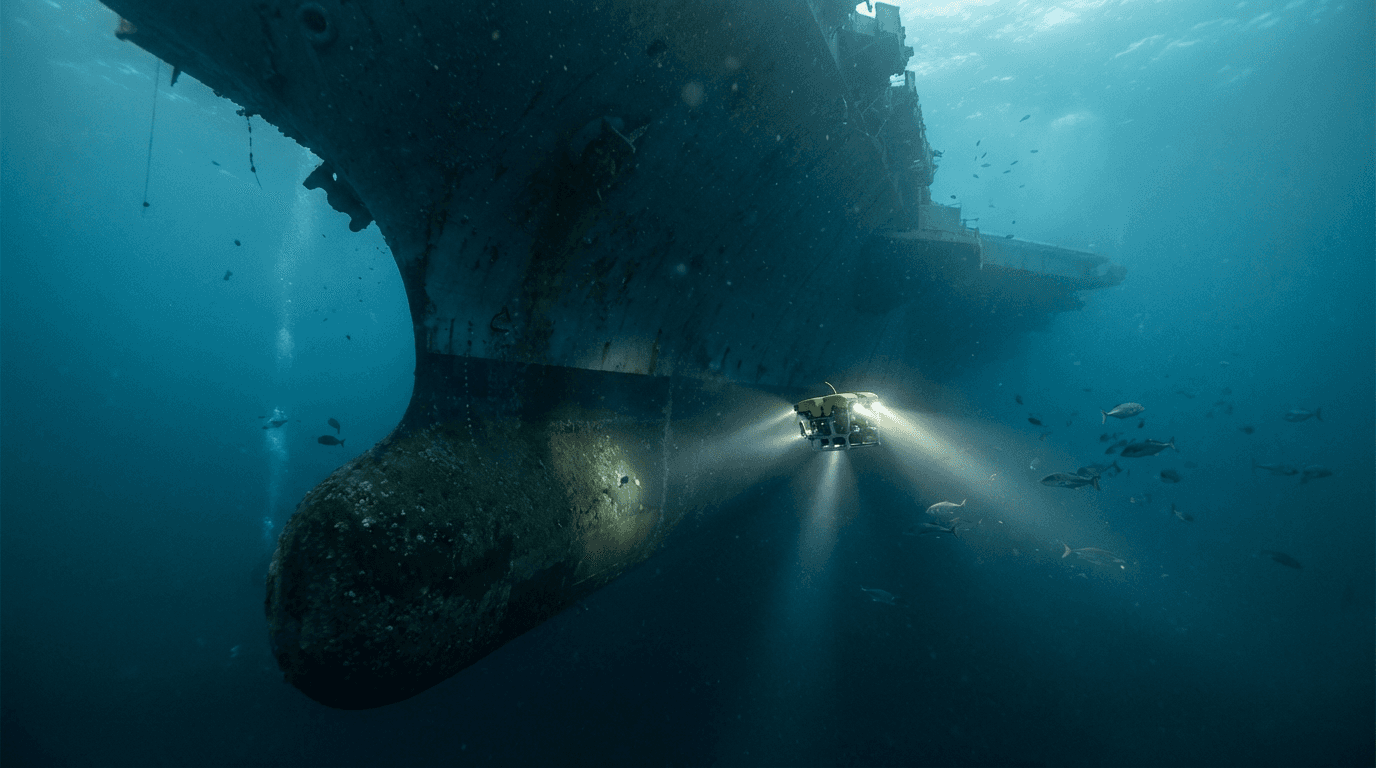
Oceaneering International, based in Houston, is the world's largest operator of ROVs. Their fleet includes work-class and inspection systems for applications ranging from routine to extreme. They operate remote operations centers in Stavanger, Morgan City, Aberdeen, and Macaé, meaning a pilot in Norway can be operating an ROV on a platform off Angola. A recent Esso Angola contract valued at $80–$90 million over three years covered advanced ROVs, intervention systems, satellite communications, and subsea inspection services.
The ROVs themselves are operated via tether from a support vessel or shore, equipped with HD cameras, sonar, and manipulator arms. Some can be fitted with crawler mechanisms that let them move over the surface of a ship's hull. TSC Subsea's ART (Acoustic Resonance Technology) can perform ultrasonic thickness measurement through coatings, meaning you can measure steel degradation without stripping the paint. That's a massive efficiency gain.
The observation-class ROV market is projected to grow from $159 million in 2025 to $248 million by 2031. Small numbers relative to the broader subsea market, but the growth rate (7.9% CAGR) tells you where the industry is heading.
The Computer Vision Revolution (and What We're Getting Wrong)
Today's AI-powered inspection systems represent the latest evolution in this progression. All three major classification societies, DNV, Bureau Veritas, and ABS, have established formal frameworks for accepting drone-based and remote inspections.
But here's where I'll be blunt: we're making the same fundamental mistake that every previous generation of inspectors made, assuming that new technology automatically improves inspection quality.
What's Working
The classification societies are moving fast. Bureau Veritas has been performing remote surveys since 2020, with no BV surveyor on board. They've established 8 remote survey centers worldwide (Istanbul, Dubai, Singapore, Shanghai, Paris, Miami, Rotterdam, Piraeus) with more than 125 surveyors trained for remote work. In June 2025, BV launched Augmented Surveyor 3D, an AI- and machine-learning-powered tool for anomaly detection. They completed a proof-of-concept with TotalEnergies on an FPSO in West Africa, using drone-based inspection of ballast tanks to generate 3D digital models with AI-enhanced corrosion analytics.
DNV approved suppliers to provide close-up surveys using remote inspection techniques (drones, climbers, and ROVs) starting in January 2019. Bureau Veritas issued Guidance Note NI693 in May 2025 defining exactly how remote inspection techniques can substitute for physical surveyor access.
On the startup side, ABS partnered with Google Cloud and SoftServe to develop image recognition software that detects corrosion and coatings breakdowns on brown- and bluewater vessels. Deep Trekker is leading an $8.1 million AI ROV Ship Modeling and Detection Project with Canada's Ocean Supercluster, Qii.AI, the Department of National Defence, Kongsberg Discovery, and ABS, using machine learning to analyze sonar and video footage for structural defects, corrosion, and biofouling.
Kaiko Systems, a Berlin-based startup that raised €6 million in Series A funding ($12.3M total raised), deploys an AI agent called KAI that analyzes inspection photos uploaded by crew members to detect corrosion, structural damage, and coating issues in real time. They serve over 1,000 vessels globally, and clients report a 30% reduction in unplanned downtime and inspections completed 25% faster.
Computer vision systems can detect defects that human inspectors miss. Hairline cracks invisible to the naked eye, subtle corrosion patterns indicating systemic problems, or geometric deviations measured in millimeters. One emerging approach uses YOLOv5 object detection and ORB-SLAM3 for 3D reconstruction, enabling autonomous underwater drones to navigate and inspect mooring systems without human piloting.
What's Not
The technology is advancing faster than our understanding of how to use it effectively. I've seen inspection teams collect terabytes of data but struggle to translate it into actionable insights about structural condition. ROV and AUVs have given us the ability to capture more data than ever with more meta data than ever. Surveyors are now buried in data, with less resources, more time pressure, and increasing Class standards.
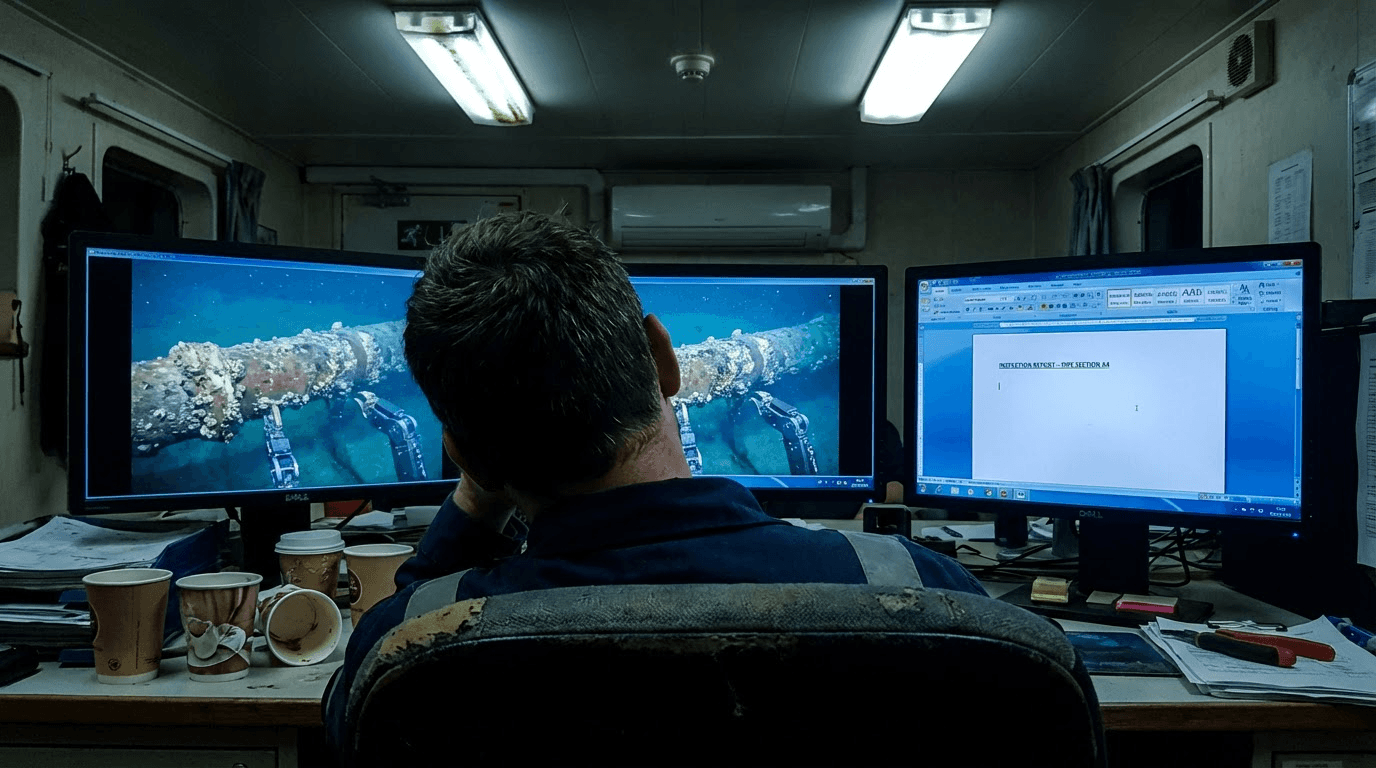
Something has to change. Offshore energy and maritime operations are hardly familiar with AI software, let alone Claude Code or “vibe coding”. Inspectors can see the value of technology in front of them (bigger, faster, cheaper robots), but are slowly treading in the hidden costs of complexity. With less or no staff on site for inspections, context is loss even though more data is handed off. Nowadays, report writing is the bottle neck.
And when a customer spends $500k on 1 day of ROV deployment, a 50 page word doc as the deliverable rarely makes them pleased with the inspection as a whole.
The historical parallel is right there in the record. X-ray inspection in the 1950s took years before the industry developed reliable interpretation standards. We're on the same learning curve with AI-powered inspection, just moving faster and with less tolerance for error. Reports that unlock ship deployments or other marine assets are still bottlenecked by the manual and analog report writing workflows.
As DNV notes, the ESP Code (Enhanced Survey Programme) is not clear on the applicability of remote inspection techniques, which means flag state authorities must individually approve RIT before it can be used for class surveys on oil tankers and bulk carriers. The technology exists, but the regulatory framework hasn't caught up.
In the meantime, companies and inspectors will drown in more data, but walk out with less clarity.
The Integration Problem
Lloyd's Register's recent digital transformation reflects this challenge at scale. In June 2022, LR acquired OneOcean, a leading supplier of voyage compliance, safety, and environmental solutions. In 2023, they unified under OneOceanLR, incorporating Hanseaticsoft (fleet management), i4 Insight, C-MAP Commercial, Greensteam (vessel performance), and ISF Watchkeeper (crew compliance). In 2024, LR acquired OTG (Ocean Technologies Group) from Oakley Capital, a maritime human capital management software provider.
As LR Group CEO Nick Brown put it, with OTG and OneOcean combined, LR now offers solutions across a fleet of over 30,000 vessels globally.
Successful inspection organizations don't just adopt new technology. They integrate it with existing expertise and procedures. But integration is harder than adoption. It's relatively easy to deploy AI-powered defect detection algorithms. It's much harder to weave those results into traditional surveyor judgment, regulatory requirements, and operational constraints.
Three Patterns That Predict What Comes Next
Looking at 260 years of inspection evolution, several patterns emerge that I think are predictive:
1) Technology serves standards, not the other way around.
Every successful inspection technology has been adapted to serve existing quality standards rather than trying to redefine them. As classification experts note, today a ship either meets class rules or it doesn't. Classification societies certify that a vessel complies with their rules, and the reputation of the veracity of those rules is what gives them prestige. AI-powered inspection will succeed when it helps achieve better compliance with established structural integrity requirements, not when it tries to replace those requirements with novel metrics.
2) Scale enables innovation.
Lloyd's Register's global expansion enabled standardization that local surveyors couldn't achieve. The most successful inspection technologies will be those that operate consistently across diverse marine environments and regulatory frameworks. IACS currently includes 12 member societies (ABS, BV, CCS, CRS, DNV, IRS, KR, LR, NK, PRS, RINA, and Türk Loydu), and any technology that wants to be adopted at scale needs to work within all of their frameworks.
3) Integration takes 10–20 years.
Every major technological shift in inspection methodology has required a decade or two to mature from initial adoption to reliable operational use. Computer vision and AI-powered inspection are following the same timeline, whether the venture pitch decks acknowledge it or not.
My Prediction for the Next Decade
Based on these historical patterns:
2025–2027: Continued experimentation with AI algorithms and autonomous systems, but limited operational adoption. Regulatory uncertainty, particularly around the ESP Code's silence on remote inspection applicability, keeps things in pilot mode. Companies like Kaiko, Deep Trekker, and Qii.AI prove the technology works; the question is whether class societies and flag states will accept it at scale.
2027–2030: Emergence of hybrid inspection approaches that combine human surveyor expertise with AI-powered defect detection, similar to how X-ray inspection complemented rather than replaced visual inspection in the mid-20th century. Bureau Veritas's Augmented Surveyor 3D model (AI-enhanced analytics layered on top of surveyor judgment) is likely the template.
2030–2035: Full integration of computer vision systems into standard inspection workflows. AI algorithms become as routine as ultrasonic testing is today. The roughly 40% of smaller companies currently postponing drydocking due to operational downtime and costs will drive adoption of AI-assisted UWILD as a more affordable, less disruptive alternative.
The companies that succeed will be the ones that understand this historical pattern and position for gradual evolution rather than revolutionary disruption.
The Enduring Principles
The fundamental principles that guided Edward Lloyd's surveyors in 1764 remain relevant today. Systematic rather than ad-hoc assessment. Standardized procedures that enable consistent results. Documentation that can be understood and trusted by stakeholders. Continuous adaptation to technological and operational change.
Computer vision and AI represent powerful new tools for applying these principles, but they don't change the principles themselves.
Standing in that archive room, looking at 260 years of survey reports, the continuity is remarkable. The handwriting changes, the forms evolve, the technology advances, but the core mission stays the same. Ships need to be safe. Hull integrity must be verified. Professional judgment must be documented and trusted.
We've traded chalk marks for computer vision, but we're still in the same business Edward Lloyd started in 1760.
The next chapter of that story is being written right now, one inspection at a time.
If you made it to the end (or skimmed out of interest but still care), email me at alexa@manta.inc.
Appendix: Sources
Lloyd's Register. "Our History." Lloyd's Register, accessed March 2026. https://www.lr.org/en/about-us/who-we-are/our-history/
Lloyd's Register. "Edward Lloyd's Coffee House." Lloyd's Register, accessed March 2026. https://www.lr.org/en/about-us/who-we-are/our-history/edward-lloyd-coffee-house/
Lloyd's Register Foundation. "Heritage & Education Centre: Archive & Library." Lloyd's Register Foundation, accessed March 2026. https://hec.lrfoundation.org.uk/archive-library/ships/maltese-cross-1900
Royal Museums Greenwich. "Research Guide H5: Lloyd's Registers Held by the National Maritime Museum." Royal Museums Greenwich, accessed March 2026. https://www.rmg.co.uk/collections/research-guides/research-guide-h5-lloyds-registers-held-national-maritime-museum
University of Oxford. "Case Study #13: The 'A1' Reputation of the Lloyd's Register of Shipping." Global Capitalism History, Oxford University, accessed March 2026. https://globalcapitalism.history.ox.ac.uk/files/case13-lloydsregisterpdf
Wikipedia. "Lloyd's Register." Wikimedia Foundation, last modified 2025. https://en.wikipedia.org/wiki/Lloyd's_Register
Maritime Cyprus. "Lloyd's Register: It All Started with a Cup of Coffee." Maritime Cyprus, January 5, 2018. https://maritimecyprus.com/2018/01/05/lloyds-register-it-all-started-with-a-cup-of-coffee-3/
Precedence Research. "Subsea and Offshore Services Market Size, Share, and Trends 2025 to 2034." Precedence Research, 2024. https://www.precedenceresearch.com/subsea-and-offshore-services-market
Business Research Insights. "Dry Docking Services Market Report." Business Research Insights, 2024. https://www.businessresearchinsights.com/market-reports/dry-docking-services-market-115181
Marine Public. "Dry Docks and Surveys: Types, Requirements, Regulations." Marine Public, accessed March 2026. https://www.marinepublic.com/blogs/marine-law/922687-dry-docks-and-surveys-types-requirements-regulations
Wikipedia. "International Association of Classification Societies." Wikimedia Foundation, last modified 2025. https://en.wikipedia.org/wiki/International_Association_of_Classification_Societies
Nautilus Shipping. "A Guide to Types of Surveys for Ships: What You Need to Know." Nautilus Shipping, accessed March 2026. https://nautilusshipping.com/news-and-insights/different-types-of-ship-surveys-a-complete-guide
Oitha Marine. "The Economics of Dry Docking a Cargo Ship: Costs, Benefits, and Financial Considerations." Oitha Marine, accessed March 2026. https://oithamarine.com/the-economics-of-dry-docking-a-cargo-ship-costs-benefits-and-financial-considerations/
Marine Insight. "The Ultimate Guide to Dry Docks: Types, Functions, and Essential Requirements." Marine Insight, accessed March 2026. https://www.marineinsight.com/guidelines/dry-dock-types-of-dry-docks-requirements-for-dry-dock/
ShipFinex. "Ship Operating Costs: Maritime Vessel Expenses." ShipFinex, accessed March 2026. https://www.shipfinex.com/blog/ship-operating-costs-maritime-vessel-expenses
TSC Subsea. "Subsea NDT for FPSO and Shipping Vessels." TSC Subsea, accessed March 2026. https://www.tscsubsea.com/subsea-ndt-fpso-shipping-vessels/
Deep Trekker. "What You Need to Know About Conducting an Effective UWILD." Deep Trekker, accessed March 2026. https://www.deeptrekker.com/resources/uwild-best-practices
Cornell Law Institute. "46 CFR § 115.615 - Underwater Survey." Legal Information Institute, Cornell Law School, accessed March 2026. https://www.law.cornell.edu/cfr/text/46/115.615
Innospection. "Underwater Inspection in Lieu of Drydocking (UWILD)." Innospection, accessed March 2026. https://www.innospection.com/en/services/splash-zone-subsea-inspection/underwater-inspection-in-lieu-of-drydocking-uwlid
EM&I Alliance. "ODIN Inspection: Diverless UWILD." EM&I Alliance, accessed March 2026. https://emialliance.com/innovative-services/odin-inspection-diverless-uwild/
Oceaneering International. "ROV Services: ROV Systems." Oceaneering International, accessed March 2026. https://www.oceaneering.com/rov-services/rov-systems/
Wikipedia. "Oceaneering International." Wikimedia Foundation, last modified 2025. https://en.wikipedia.org/wiki/Oceaneering_International
Yahoo Finance. "Oceaneering Wins ROV Services Contract." Yahoo Finance, 2024. https://finance.yahoo.com/news/oceaneering-wins-rov-services-contract-120400172.html
Unmanned Systems Technology. "Underwater Inspection." Unmanned Systems Technology, accessed March 2026. https://www.unmannedsystemstechnology.com/expo/underwater-inspection/
IntelMarketResearch. "Observation/Inspection Class ROV Market." IntelMarketResearch, 2025. https://www.intelmarketresearch.com/observationinspection-class-rov-market-9764
DNV. "Survey by Remote Inspection Techniques: Use of Approved Service Suppliers." DNV, accessed March 2026. https://www.dnv.com/news/survey-by-remote-inspection-techniques-use-of-approved-service-suppliers-144572/
Bureau Veritas. "Tech-Enabled Surveys: Remote & Augmented Surveys." Bureau Veritas Marine & Offshore, accessed March 2026. https://marine-offshore.bureauveritas.com/digital-classification/remote-augmented-surveys
Bureau Veritas. "Bureau Veritas Launches AI-Powered Augmented Surveyor 3D." Bureau Veritas Marine & Offshore, June 2025. https://marine-offshore.bureauveritas.com/newsroom/bureau-veritas-launches-ai-powered-augmented-surveyor-3d-next-generation-remote-inspection
Bureau Veritas. "Guidance Note NI693: Remote Inspection Techniques." Bureau Veritas, May 2025. https://erules.veristar.com/dy/data/bv/pdf/693-NI_2025-05.pdf
WorkBoat. "ABS Brings Artificial Intelligence to Vessel Corrosion." WorkBoat, accessed March 2026. https://www.workboat.com/shipbuilding/abs-brings-artificial-intelligence-to-vessel-corrosion
Ocean Science & Technology. "Deep Trekker Heads AI-Driven ROV Ship Inspection Initiative." Ocean Science & Technology, September 2024. https://www.oceansciencetechnology.com/news/deep-trekker-heads-ai-driven-rov-ship-inspection-initiative/
Kaiko Systems. "AI-Enabled Corrosion Detection in the Maritime Industry." Kaiko Systems, accessed March 2026. https://www.kaikosystems.com/
Flashpoint VC. "Kaiko Systems Raises €6M Series A Funding." Flashpoint VC, accessed March 2026. https://www.flashpointvc.com/post/kaiko-systems-raises-eu6m-series-a-funding
Frontiers in Robotics and AI. "Enabling Scalable Inspection of Offshore Mooring Systems Using Cost-Effective Autonomous Underwater Drones." Frontiers, 2025. https://www.frontiersin.org/journals/robotics-and-ai/articles/10.3389/frobt.2025.1655242/full
DRSA. "What is Lloyd's Register? Ship Classification Explained." DRSA, accessed March 2026. https://www.drsa.com/pages/what-is-lloyds-register
Lloyd's Register. "Lloyd's Register Completes Purchase of OneOcean." Lloyd's Register Press Room, June 2022. https://www.lr.org/en/knowledge/press-room/press-listing/press-release/2022/lloyds-register-completes-purchase-of-oneocean/
Lloyd's Register. "Lloyd's Register Unifies Its Digital Offering with OneOceanLR." Lloyd's Register Press Room, 2023. https://www.lr.org/en/knowledge/press-room/press-listing/press-release/2023/lloyds-register-unifies-its-digital-offering-with-oneoceanlr/
Lloyd's Register. "Lloyd's Register Completes Acquisition of Ocean Technologies Group." Lloyd's Register Press Room, 2024. https://www.lr.org/en/knowledge/press-room/press-listing/press-release/2024/lloyds-register-completes-acquisition-of-ocean-technologies-group/
The Maritime Executive. "Lloyd's Register Acquires Ocean Technology Group, Expanding Digital Platform." The Maritime Executive, 2024. https://maritime-executive.com/article/lloyd-s-register-acquires-ocean-technology-group-expanding-digital-platform
Swim with us
The latest in AI and marine surveying. Unlock the depths with AI.