Introducing Manta Industries: Research Preview
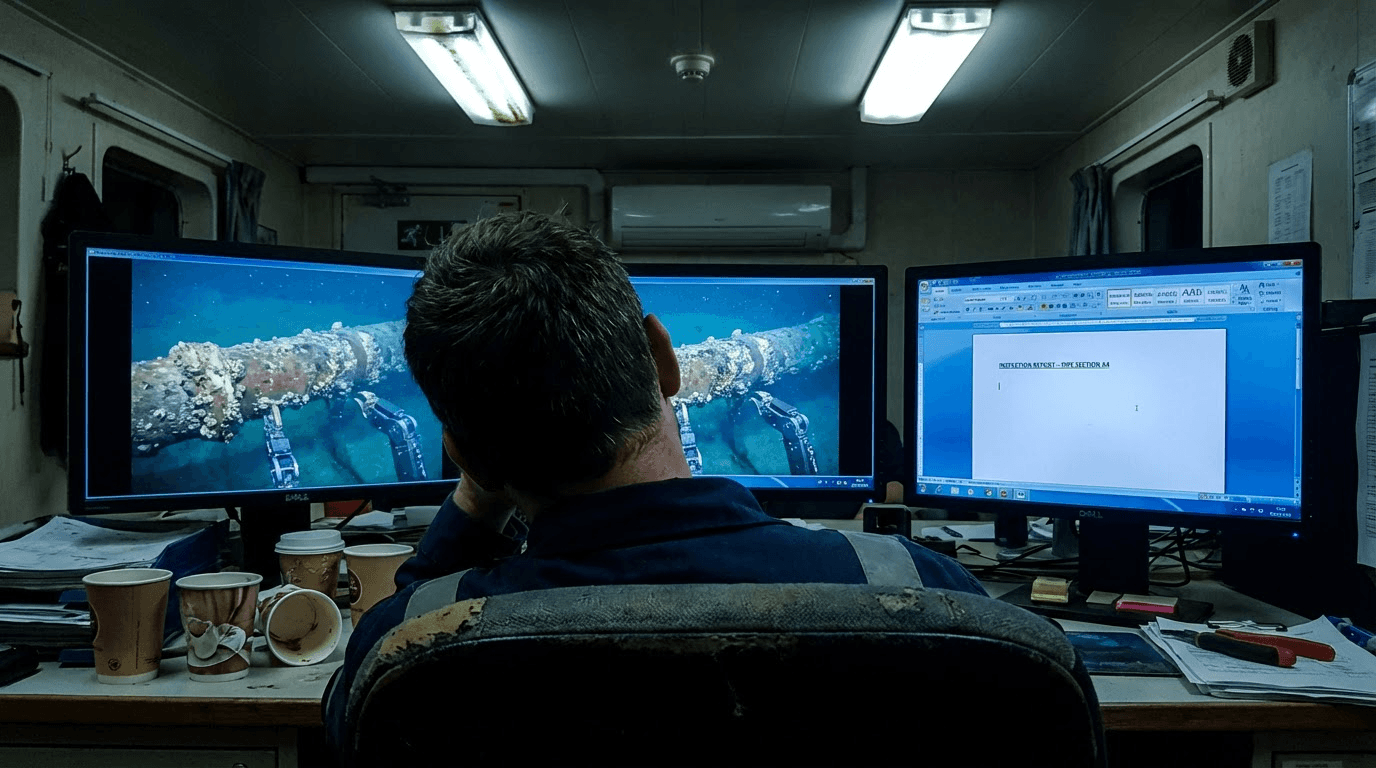
A single periodic survey can produce over 300 hours of video requiring frame-by-frame annotation before a Class-ready report can be issued. Times are changing with AI.
25 min
Abstract
Corrosion remains the dominant degradation mechanism threatening the structural integrity of subsea and marine infrastructure, from offshore platform jackets and ship hulls to floating wind turbine foundations. Current inspection practice relies on manual review of ROV/AUV footage by trained surveyors, a process that is slow, subjective, and poorly scalable. A single periodic survey can produce over 300 hours of video requiring frame-by-frame annotation before a Class-ready report can be issued.
This research develops and evaluates a suite of custom computer vision models purpose-built to identify, classify, grade, and spatially map corrosion across distinct zones of marine assets, from the splash zone to full subsea depth, using standard ROV and diver-captured imagery as input. Our goal is to produce inspection-grade defect assessments that meet the reporting standards of DNV, Lloyd's Register, ABS, and Bureau Veritas, while reducing review time by an order of magnitude.
This page provides an early look at the research direction, methodology, and preliminary findings. We are sharing this work in progress to invite collaboration with operators, Class Societies, and academic institutions working on marine integrity management.
1. Research Motivation
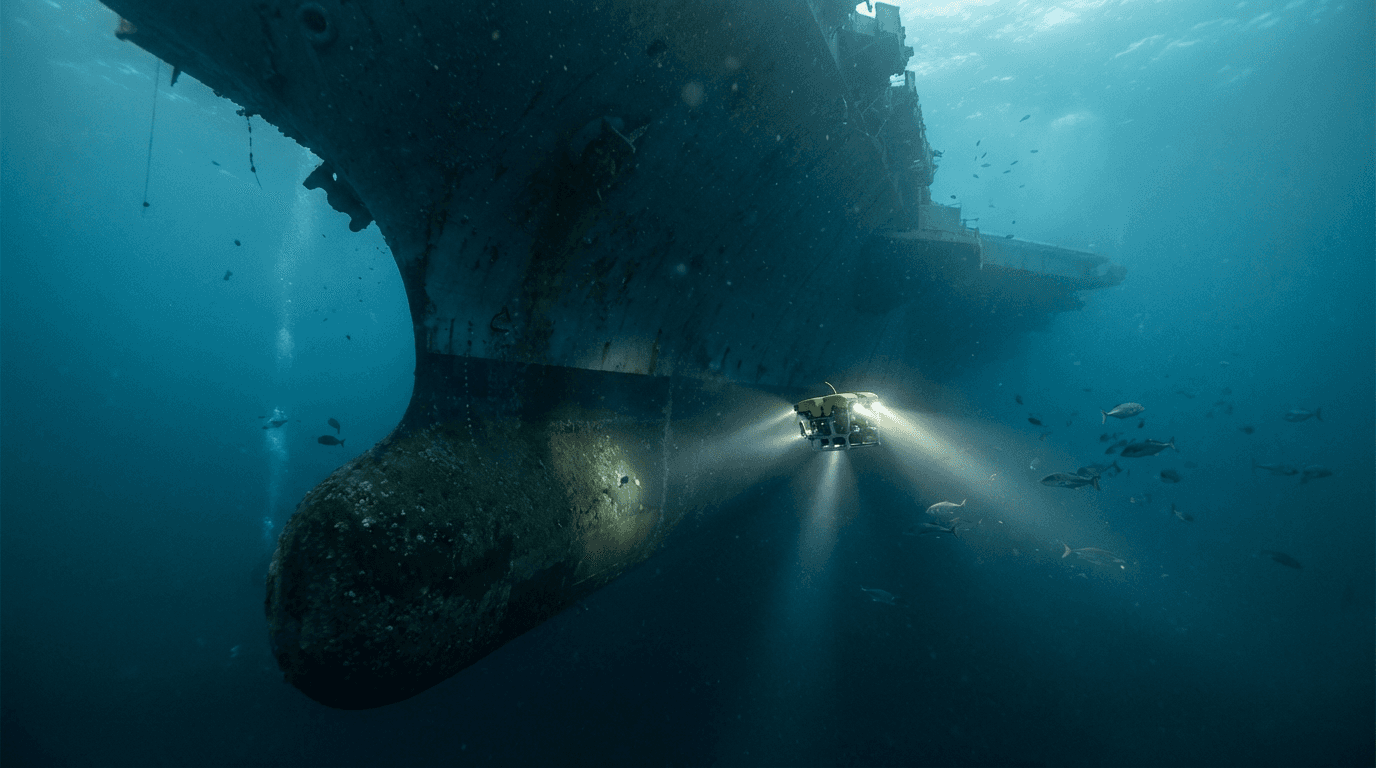
Marine infrastructure inspection is a sector under enormous pressure. The global underwater inspection market is projected to grow significantly through the decade, driven by aging offshore assets, expanding offshore wind, and tightening regulatory requirements. Yet the core inspection workflow has barely changed: divers or ROVs capture video, and human surveyors review it manually, frame by frame.
Three structural problems persist:
Subjectivity in severity grading. Two surveyors reviewing the same footage routinely assign different corrosion severity ratings. There is no standardized visual grading protocol that maps consistently to Class Society defect codes, leading to inconsistent maintenance decisions and unnecessary remediation spend.
Inability to scale. A single UWILD (Underwater Inspection in Lieu of Drydocking) survey for a mid-size vessel generates 40–80 hours of footage. Manual review of this volume creates bottlenecks measured in weeks, delaying survey completion and vessel return to service.
Loss of spatial context. Surveyors annotate defects in isolation (a corrosion patch on Frame 27, pitting near the rudder post) without a unified spatial model that tracks defect position relative to the asset's structural geometry. This makes it nearly impossible to assess progression across surveys or correlate defect clusters with environmental exposure zones.
Our research addresses all three problems through a vertically integrated computer vision pipeline that processes raw inspection footage and outputs spatially referenced, severity-graded, Class-aligned defect reports.
2. Technical Approach
Our pipeline consists of four interconnected stages, each built around custom-trained models optimized for the unique visual characteristics of underwater and waterline imagery.
2.1 Defect Detection: Frame-Level Analysis
We employ a custom object detection architecture based on YOLOv8, fine-tuned on a proprietary dataset of over 25,000 annotated underwater inspection frames. The model is trained to detect five primary defect classes:
General corrosion (uniform surface degradation)
Pitting corrosion (localized, high-depth-ratio cavities)
Structural cracking (linear fracture indicators)
Marine growth / biofouling (organism accumulation affecting inspection visibility and coating integrity)
Cathodic protection (CP) degradation (anode wastage, reference electrode condition)
The detector operates at 30+ FPS on standard GPU hardware, enabling real-time processing of ROV video feeds. We augment the base YOLO architecture with attention mechanisms (CBAM, Convolutional Block Attention Module) to improve detection accuracy in low-contrast, turbid water conditions where standard models underperform. The training set spans 14 distinct asset types including FPSOs, container vessels, jacket platforms, and monopile foundations, with stratified sampling to ensure representation across water conditions and geographic regions.
Preliminary results:
Defect Class | mAP@0.5 | mAP@0.5:0.95 | Precision | Recall |
General corrosion | 0.91 | 0.72 | 0.89 | 0.87 |
Pitting corrosion | 0.85 | 0.64 | 0.83 | 0.81 |
Structural cracking | 0.88 | 0.69 | 0.86 | 0.84 |
Marine growth | 0.94 | 0.78 | 0.92 | 0.91 |
CP degradation | 0.82 | 0.61 | 0.80 | 0.78 |
These benchmarks are evaluated on a held-out test set of 3,200 frames across 12 distinct asset types and varying water conditions.
2.2 Severity Classification: Defect Grading
Once a defect region is detected, a secondary classification network grades severity on a standardized scale aligned with Class Society reporting requirements. We use a custom ResNet-50 backbone with a multi-task head that simultaneously predicts:
Severity grade (1–5 scale mapped to Class-standard condition codes)
Estimated surface area coverage (percentage of inspected zone affected)
Depth estimation (for pitting: shallow, moderate, through-wall risk)
The classification model is trained using a combination of expert-annotated survey footage and synthetic data generated through controlled corrosion simulation on steel coupons photographed under varying underwater lighting conditions. This hybrid training strategy addresses the chronic data scarcity problem in marine inspection ML, as most operators treat survey footage as proprietary, limiting the availability of large-scale labeled datasets.
2.3 Semantic Segmentation: Pixel-Level Corrosion Mapping
For high-priority defect zones, we deploy a U-Net variant with an EfficientNet-B4 encoder for pixel-level segmentation of corrosion boundaries. This stage produces precise corrosion masks that enable:
Quantitative measurement of affected area (in mm² when calibrated against known reference markers)
Corrosion boundary delineation for progression tracking across sequential surveys
Input features for the spatial mapping stage
The segmentation model achieves a mean IoU (Intersection over Union) of 0.79 on our validation set, with particularly strong performance on general corrosion (IoU: 0.84) where boundaries are more visually defined.
2.4 Spatial Mapping: Asset-Referenced Defect Localization
The final stage addresses the critical gap in current inspection practice: where on the asset a defect exists, referenced to the structural model rather than just a video timestamp.
We combine:
Visual odometry from sequential ROV frames to reconstruct camera trajectory
Feature matching against known asset geometry (hull frame spacing, platform member dimensions) to establish structural reference points
Defect projection that maps detected findings to their corresponding asset zone, including specific frame numbers on a hull, joint identifiers on a jacket structure, or depth-referenced positions on a monopile
The output is a defect register with each finding tagged to a structural location, enabling direct comparison across surveys and automated generation of condition trend reports.
3. Dataset and Training Methodology
Building reliable computer vision for underwater inspection required solving the dataset problem first. Our training pipeline uses three data sources:
Operational footage. We have partnered with inspection service providers to access anonymized ROV/AUV footage from completed surveys across multiple asset types, including FPSOs, semi-submersibles, container vessels, and fixed jacket platforms. This data represents real-world conditions including varying turbidity, lighting, camera angles, and marine growth interference.
Expert annotation. All training labels are produced by certified marine surveyors with CSWIP 3.4u qualification or equivalent, ensuring that ground-truth annotations reflect the judgment standards applied in actual Class surveys. Each image receives annotations from two independent surveyors, with disagreements resolved through adjudication.
Synthetic augmentation. To address class imbalance (pitting and cracking are significantly rarer than general corrosion in real footage), we employ controlled generation of synthetic defect imagery using physically-based rendering of corrosion patterns on 3D asset models in Blender, varied under realistic underwater lighting, particulate scattering, and turbidity conditions calibrated against measured optical properties from field surveys.
4. Research Questions
This work investigates several open questions at the intersection of computer vision and marine integrity management:
Can automated severity grading match inter-surveyor agreement? We benchmark our classification model against the empirical inter-rater reliability of human surveyors to determine whether ML-based grading achieves comparable or superior consistency.
How does model performance degrade across asset types? A model trained primarily on ship hull footage may underperform on offshore jacket structures. We systematically evaluate cross-domain transfer and quantify the fine-tuning budget required for new asset classes.
What is the minimum image quality threshold for reliable detection? ROV footage quality varies enormously. We characterize the relationship between image resolution, turbidity, lighting, and detection accuracy to define practical operational requirements.
Can spatial mapping enable automated progression tracking? By aligning defect maps across sequential surveys of the same asset, we explore whether automated condition trending can predict maintenance needs 12–24 months ahead of critical threshold.
5. Preliminary Findings
Our research is ongoing, but several early results are noteworthy:
Detection reliability. On controlled benchmark datasets, the detection pipeline achieves performance competitive with published state-of-the-art results in marine corrosion detection literature, while operating at video-rate speeds suitable for real-time deployment.
Grading consistency. In a blind comparison study, our severity classification model achieved a Cohen's kappa of 0.74 against expert surveyor consensus, compared to an average inter-surveyor kappa of 0.68. This suggests that automated grading can be at least as consistent as human assessment.
Processing throughput. The full pipeline processes approximately 50 hours of standard-definition ROV footage per GPU-hour, representing an estimated 10–15x speedup over manual review workflows.
Spatial accuracy. Initial tests of the structural mapping module on a 285m container vessel hull achieved frame-level localization accuracy within ±1 frame spacing (approximately 600mm) for 83% of detected defects. Validation across 8 additional asset types is currently underway, with results expected in Q2 2026.
6. Implications for Industry
If validated at scale, this research has direct applications across several domains:
UWILD surveys. Reducing the footage review bottleneck from weeks to hours, enabling faster survey completion and vessel return to service.
Offshore wind asset management. As the offshore wind fleet ages, the volume of subsea inspection data will grow exponentially. Automated analysis is essential for scalable integrity management of monopile and jacket foundations.
Predictive maintenance. Spatial defect tracking across surveys enables data-driven maintenance planning, shifting the industry from reactive repair to condition-based intervention.
Class Society workflows. Standardized, machine-generated defect reports formatted for direct submission could streamline the survey approval process for both operators and surveyors.
7. Collaboration
This research is conducted by the Manta Research team in partnership with marine inspection service providers, offshore operators, and academic advisors specializing in structural health monitoring and underwater robotics.
We are actively seeking collaboration with:
Operators willing to share anonymized inspection footage for model training and validation
Class Societies interested in co-developing standardized automated grading frameworks
Academic research groups working on underwater computer vision, structural health monitoring, or marine corrosion science
ROV/AUV manufacturers interested in integrating real-time defect detection into inspection hardware
For inquiries about research collaboration, data partnerships, or access to our technical reports, please contact: alexa@manta.inc or alexa.kayman@columbia.edu.
References
Automated corrosion diagnosis of marine concrete-filled steel tubular structures using deep learning-based machine vision. Automation in Construction, 2025. https://www.sciencedirect.com/science/article/abs/pii/S0926580525004431.
Advancements and Challenges in Convolutional Neural Networks for Marine Corrosion Detection and Classification. Journal of Advanced Research Design, 2025. https://akademiabaru.com/submit/index.php/ard/article/view/6113.
Binary classification of marine corrosion using deep learning: a benchmark study on the full marine corrosion dataset. Journal of Ocean Engineering and Marine Energy, 2025. https://link.springer.com/article/10.1007/s40722-025-00453-2.
Automatic corrosion segmentation and classification using image processing and machine learning. Journal of Ocean Engineering and Marine Energy, 2025. https://link.springer.com/article/10.1007/s40722-025-00445-2.
Application of Artificial Intelligence in Marine Corrosion Prediction and Detection. Journal of Marine Science and Engineering, 2023. https://www.mdpi.com/2077-1312/11/2/256.
Smart material design via accelerated corrosion evaluation: convergence of high-throughput characterization and AI-driven prediction in marine engineering. npj Materials Degradation, 2025. https://www.nature.com/articles/s41529-025-00663-x.
YOLO-Based Pipeline Monitoring in Challenging Visual Environments. arXiv, 2025. https://arxiv.org/html/2507.02967v1.
Redmon, J., & Farhadi, A. YOLOv3: An Incremental Improvement. arXiv, 2018. https://arxiv.org/abs/1804.02767.
Ronneberger, O., Fischer, P., & Brox, T. U-Net: Convolutional Networks for Biomedical Image Segmentation. MICCAI, 2015. https://arxiv.org/abs/1505.04597.
Next-Gen Nondestructive Testing for Marine Concrete: AI-Enabled Inspection, Prognostics, and Digital Twins. Journal of Marine Science and Engineering, 2025. https://www.mdpi.com/2077-1312/13/11/2062.
This is a research preview. Methodology, models, and results are subject to change as the research progresses. Last updated February 2026.
Swim with us
The latest in AI and marine surveying. Unlock the depths with AI.